An Introduction to Domain Names
When it comes to learning about the internet, the first item you will learn about is the domain name. If you are setting up a new business, you will begin to look at the domain names which are available to register, for customers to find your website and purchase your products and services.
- Home
- Knowledge Base
- An Introduction to Domain Names
Before learning what a domain name is, you first need to know what the internet is, which is a global network of computers and servers that are connected by cables or wireless technologies.
This allows for the various computers and devices to send and receive data but in order to do this, they need an address to identify the computer, server or device to send or receive data from.
An IP address is used to identify each computer or device, which is a series of numbers that looks like:
185.151.30.226
However, trying to remember a series of numbers to visit a computer, server or website can be difficult and domain names were created to solve this problem.
Instead of entering an IP address to visit a website, users type an easy to remember name within the address bar of the web browser, or what is known as, a domain name. So instead of typing in the IP address, 185.151.30.226, you would instead use the domain name, www.techible.net, providing a friendly alternative for humans.
To understand how this process works, let's take a look what takes place when you visit a website.
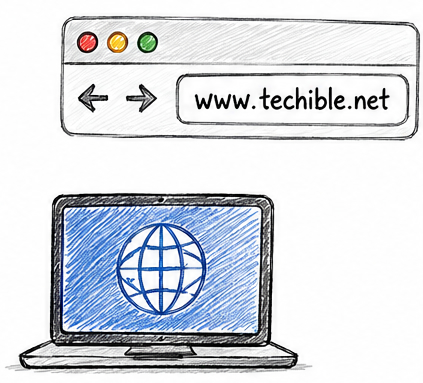
Step 1
You enter the domain name or website address, such as www.techible.net into the web browser's address bar.

Step 2
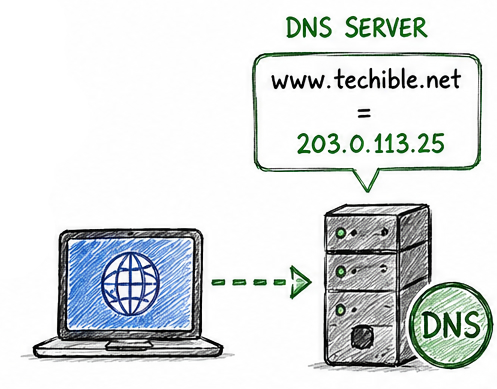
The browser visits a DNS or 'Domain Name Service', to find the domain name and the IP address which it is mapped to.
Step 3
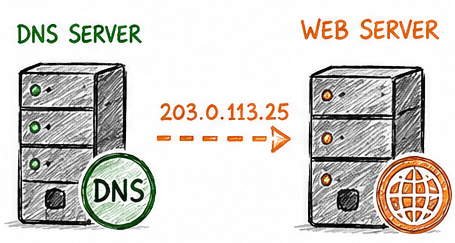
The DNS server then redirects the request to the IP address which is normally located on a web server.
Step 4
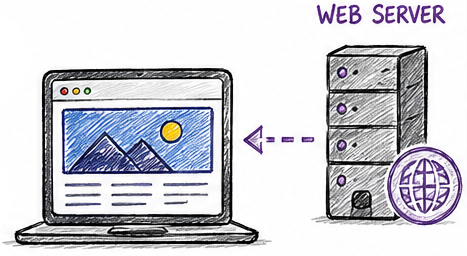
The web server locates and returns the data or website, which was originally requested, sending it to your web browser to be viewed.

Parts Of A Domain Name
When it comes to the structure of the domain name, the first thing to understand is that the domain name and the website you are viewing are two separate entities. Think of it like a physical, postal address where the domain name is the address and the website, is the building at that address.
The structure of a domain name is split into 3 components and if we use, www.google.com, as an example, it is broken down into the following:
- www: Used as the default subdomain which is traditionally associated with the 'World Wide Web', indicating a publicly available website which can be accessed over the internet.
- google: The name chosen and registered by the website owner.
- .com: Known as the domain extension, it is formally recognised as the 'TLD', or 'Top Level Domain', structure.
The Subdomain
A subdomain is an additional component which is placed before the main domain name, for example, using www.google.com, google.com is the main domain whereas www is the subdomain.
Businesses and individuals will use subdomains to separate different parts of their online services, using subdomains such as:
- blog.google.com
- support.google.com
- business.google.com
- account.google.com
The Domain Extension
The component at the end of a domain name, known as the TLD or 'Top Level Domain', can use the following common, or typical examples:
- .com: Commercial and general purpose websites.
- .org: Organisations, although not exclusively.
- .net: Originally associated with networks.
- .co.uk: Normally associated with domain name owners located in the United Kingdom.
- .uk: Another domain extension which associated with domain name owners located in the United Kingdom.
- .edu: Educational institutions, primarily in the US.
- .gov: Government organisations, with eligibility restrictions.
- .io: Originally the British Indian Ocean Territory; widely used by technology companies.
There are also other extensions such as .tech, .shop, .online along with many others which can be used. The availability of different or unique domain extensions depends on the domain registrar, which are private companies and organisations that are used by domain name owners to purchase and manage their domain names.
Registering A Domain Name
Before registering a domain name, it's important to note that when using or purchasing a domain name, other services such as email, website hosting and software need to be setup and configured separately.
However, when you are in the process of registering a domain name, you will start with finding a domain registrar. Once you have decided on the domain registrar that you want to use, they will allow you to search for the domain name you want and, if it is available, register it for a specified period, normally one or more years.
If another person or organisation has already registered the domain name you want, you would need to choose another domain name. However, if it's possible, you may be able to negotiate with the current owner or registrant, to acquire the domain name you want.
A good domain name is an important part of an organisation's online identity which can:
- Make a website easier to find.
- Provide a professional online address.
- Help establish a brand.
- Be used for professional email addresses.
- Make it easier for customers to remember a business.
- Provide a consistent identity across online services.
Once the domain name registered, if required, you will then start the process of setting up the website hosting and other services such as email.
In Summary
A domain name is a unique, easy to remember name that people use to visit a website on the internet.
Further Information, Websites & Links
The following websites and links provide further information and resources if you would like to learn more.